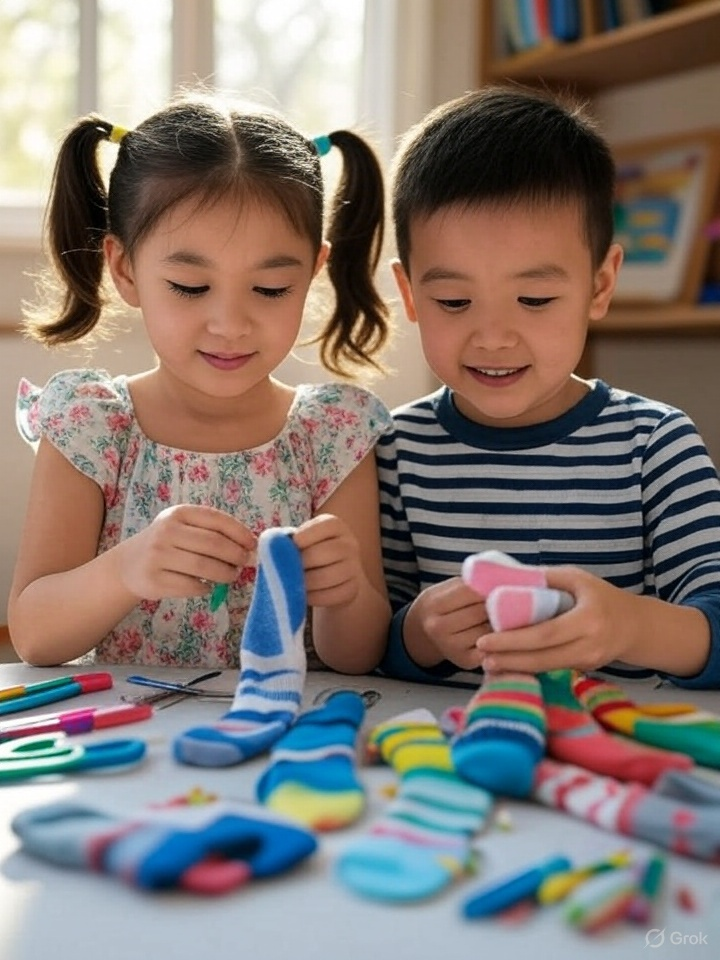

I love simple craft ideas that are fun, developmentally beneficial, and budget-friendly. My kids inspired today’s craft idea. At this very moment, they are hosting a grand wedding ceremony for their stuffed animals and their homemade sock puppets.
You may be tempted to think that this craft is too simple or potentially boring for early elementary-aged children. I can say with certainty that these are a hit! We made our sock puppets over a year ago, and they’re still holding up strong with regular use.
The best part is you most likely have everything you need right in your own home. Sock puppets can be customized to look like any person or creature your child likes! This is a great craft to use up all of your scraps and leftover pieces from previous projects.
Here’s How Sock Puppets Can Benefit Your Child:
Cognitive Development
- Encourages story sequencing and memory recall when kids act out plots.
- Boosts problem-solving as they plan characters or conflict-resolution scenes.
- Supports early language and literacy through naming, dialogue, and sound play.
Social-Emotional Learning
- Offers a safe tool for emotional expression, especially for shy or sensitive children.
- Helps with perspective-taking as kids imagine different characters’ feelings.
- Fosters self-confidence through playful performance in low-pressure settings.
Speech and Language Practice
- Strengthens articulation and vocal variety.
- Builds vocabulary and storytelling fluency through dialogue and interactive play.
- Can be adapted for speech delays or language learners by modeling clear phrases.
Fine Motor and Sensory Skills
- Encourages dexterity while gluing, stitching, and decorating.
- Allows tactile exploration with soft fabrics, buttons, yarn, and textures.
- Can integrate scissors, drawing, and hand coordination for holistic practice.
Collaborative and Dramatic Play
- Promotes group storytelling and turn-taking in puppet shows.
- Offers a medium for role-play, which builds empathy and improvisation skills.
- Allows for creative negotiation as kids co-create scripts or characters.
Let’s Get Started
Supplies: Most of these are household staples or easy craft bin finds:
- Clean mismatched socks (longer socks work best for movement)
- Buttons, pom-poms, beads, or paper circles (for eyes, noses, decorations)
- Yarn, ribbon, or fabric scraps (for hair or clothing)
- Felt or construction paper (for mouths, ears, accessories)
- Glue (school glue or low-heat glue gun with supervision)
- Scissors (child-safe for kids)
- Markers or fabric pens (for details like freckles or smiles)
- Optional: needle and thread, a hot glue gun, or fabric glue for more durable attachments
Directions:
- Choose Your Sock: Pick a sock that’s long enough to fit over a child’s hand and wrist comfortably.
- Plan Your Puppet’s Look: Decide if your puppet will be an animal, a person, a monster, or something completely unique.
- Add Eyes: Glue on buttons or paper circles near the toe end of the sock (this becomes the puppet’s face). Leave space for the mouth underneath.
- OPTIONAL: Make a Mouth: Cut an oval from felt or paper and glue it inside the sock opening for a movable mouth effect.
- Tip-Skip the cutting. Draw your mouth, teeth, or tongue instead.
- Create Hair or Ears: Use yarn for hair (tie or glue strands on top). Cut felt shapes for ears or horns.
- Decorate the Body: Add accessories like bows, scarves, or fabric “shirts” around the ankle area (wrist area when worn).
- Dry and Try It Out: Let everything dry (if using glue), then slide the puppet on and start a little skit!
Extra Ideas for Enrichment
- Make emotion puppets: happy, sad, surprised, etc. This activity is great for SEL learning.
- Use puppets for school lessons and retelling stories, especially those from read-aloud time.
- Build a simple puppet theater from a cardboard box for dramatic play.
RELATED: Magic Nature Wands