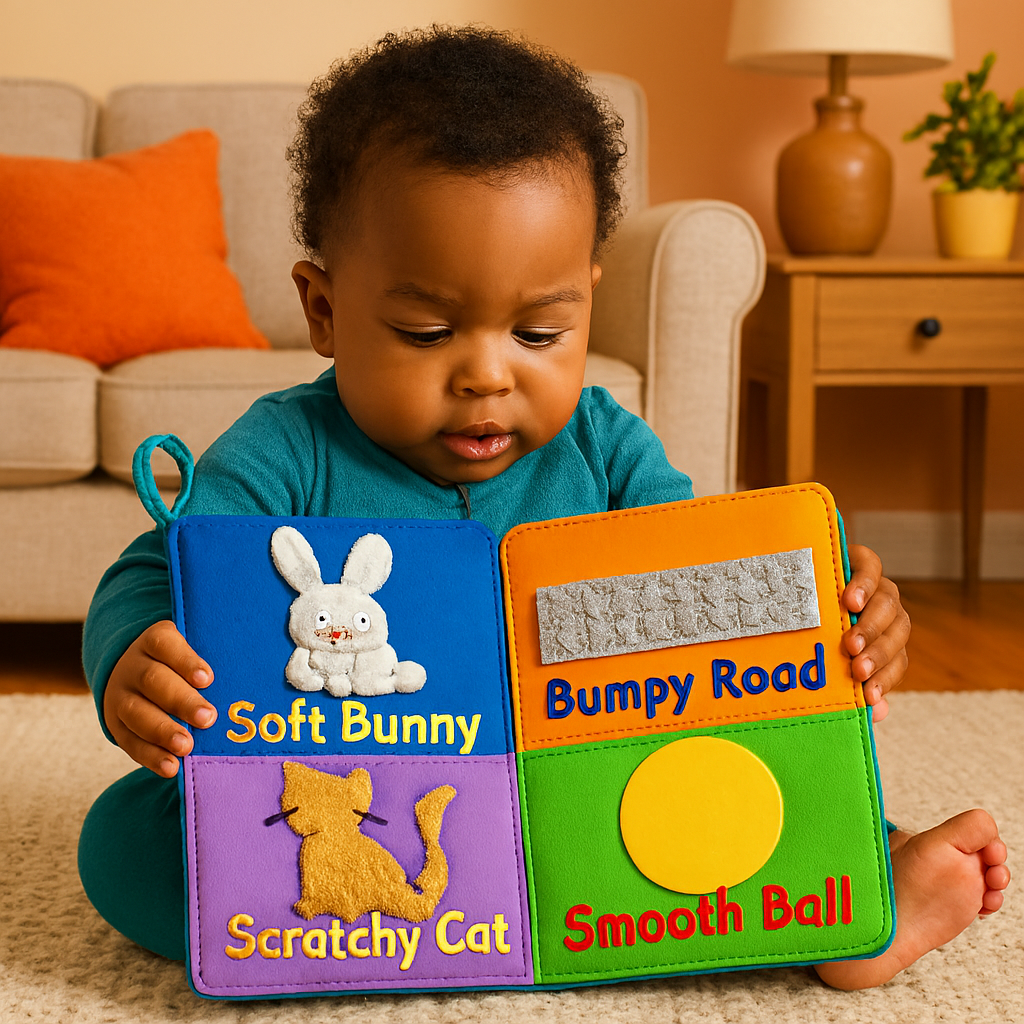

Have you ever come across a touch-and-feel book and thought: ‘I could make this?’ Well, today you can! These books are fun to make and an excellent choice for sensory enrichment for your infant. Added Bonus: You can keep the book in your child’s memory box to share with them later in life!
Let’s Take A Look At The Benefits:
1. Cognitive Development
- Stimulates curiosity through varied textures and visuals. Infants love to feel the world around them. The more variety you give them, the more they learn!
- Introduces cause and effect as babies learn that touching different materials leads to different sensations. You can reinforce their learning by labeling the texture they choose to touch. For example, if your infant touches rough-textured page, you can announce, ” oh, this one feels really bumpy!”
2. Sensory Exploration
- Enhances tactile awareness by exposing infants to soft, rough, bumpy, smooth, and crinkly textures.
- Promotes visual tracking with bold colors and high-contrast elements. Something as simple as moving the book around your infant’s play space can draw their attention to different focus points.
- Encourages auditory exploration when crinkle paper or textured elements make sounds. This adds an extra layer of sensory enjoyment for your infant!
3. Fine Motor Skills
- Strengthens grasp and finger control as babies reach, pat, and pinch textured areas.
- Improves hand-eye coordination as they reach for the book and textured spaces.
4. Language Development
- Builds vocabulary as you speak to your infant about the textures, animals, and actions (“This is soft,” “Can you touch the bumpy road?”).
- Encourages early communication through babbling, pointing, and mimicking sounds. While some sounds will automatically come before others, it’s never too early to expose your infant to variations in your spoken language.
5. Emotional & Social Bonding
- Creates shared moments between you and your baby during reading and play. You may be tempted to give your infant the book and step away, but interaction is key with this activity! Your child can’t connect the label of each texture without your help.
- Fosters trust and attachment through gentle touch and responsive interaction. Encouraging your infant to try new things will help them build confidence to do so on their own.
- Supports emotional regulation by offering calming textures and predictable routines. Just like every child has their favorite toy, infants have their favorite textures. Many infant toys are either very soft or very firm (think plastic toys). A touch-and-feel book allows them to explore new textures, to help shape their individuality.
6. Early Literacy Skills
- Introduces book handling in a safe, engaging way. Infant board books are made to be big and bulky for a reason. They get chewed on, mouthed, and thrown around aimlessly. We’re not looking for much at this age, but the simple act of holding a book allows your infant to practice for the day they advance to basic readers. Page-turning, here we come!
- Builds positive associations with books and reading from an early age. Not everyone will enjoy reading, but you can encourage the habit by keeping lots of books around the house. Use them daily as part of your routine!
Let’s Get Started!
Supplies:
- Felt sheets (various colors and textures)
- Soft fabric scraps (e.g., fleece, satin, corduroy)
- Foam shapes or padded stickers (non-toxic, no small parts)
- Velcro dots or strips (sewn or securely glued)
- Ribbon, yarn, or bias tape (for binding)
- Non-toxic fabric glue or needle and thread
- Cardboard or foam sheets (optional for structure, covered fully)
- Clear contact paper (optional for sealing pages)
Assembly Instructions:
- Cut Pages
- Cut felt sheets into uniform rectangles (e.g., 6×6 inches).
- Optional: Back each page with thin foam or cardboard, fully covered in felt.
- Add Texture Elements
- Glue or sew each texture securely onto its page.
- Avoid small parts, loose threads, or choking hazards.
- Add Simple Labels
- Use fabric markers or stitched letters to label each page (e.g., “Soft,” “Bumpy”).
- Bind the Book
- Punch holes and thread ribbon or yarn through to bind.
- Or sew pages together along one edge using a blanket stitch.
- Seal if Desired
- Cover each page with clear contact paper for durability (optional, but reduces sensory engagement).
- Make sure edges are smooth and sealed.
Page Ideas & Textures:
Each page should introduce a new texture or concept. Keep it simple and fun!
| Page Theme | Texture Element | Description |
|---|---|---|
| “Soft Bunny” | Fleece or faux fur patch | Glue a soft patch with bunny ears |
| “Bumpy Road” | Bubble wrap under felt | Sew or glue securely under a felt strip |
| “Scratchy Cat” | Burlap or rough fabric | Add felt whiskers and a tail |
| “Smooth Ball” | Satin or silk circle | Use bright colors for visual contrast |
| “Crinkly Leaf” | Crinkle paper inside felt leaf | Use snack bag or cellophane inside |
| “Velcro Cloud” | Velcro patch with removable felt | Baby can pull and stick pieces |
| “Squishy Pillow” | Stuffed felt square | Lightly padded with cotton or foam |
Important Safety Tips!
- Check regularly for wear and tear. If your book begins to fall apart, repair it or take it out of rotation.
- Always supervise your baby during playtime. Just because you tested your book for overall safety, doesn’t mean your infant won’t use their ninja skills to tear it apart.
- Avoid small detachable items or choking hazards. This book calls for large-cut textures, but each of them can be easily balled up and shoved in your infant’s mouth. Avoid using smaller cuts than recommended and always supervise. When your baby is done playing, double-check to make sure that no pieces were torn off and left behind.
- Use only non-toxic, baby-safe materials.
RELATED: Infant Texture Board