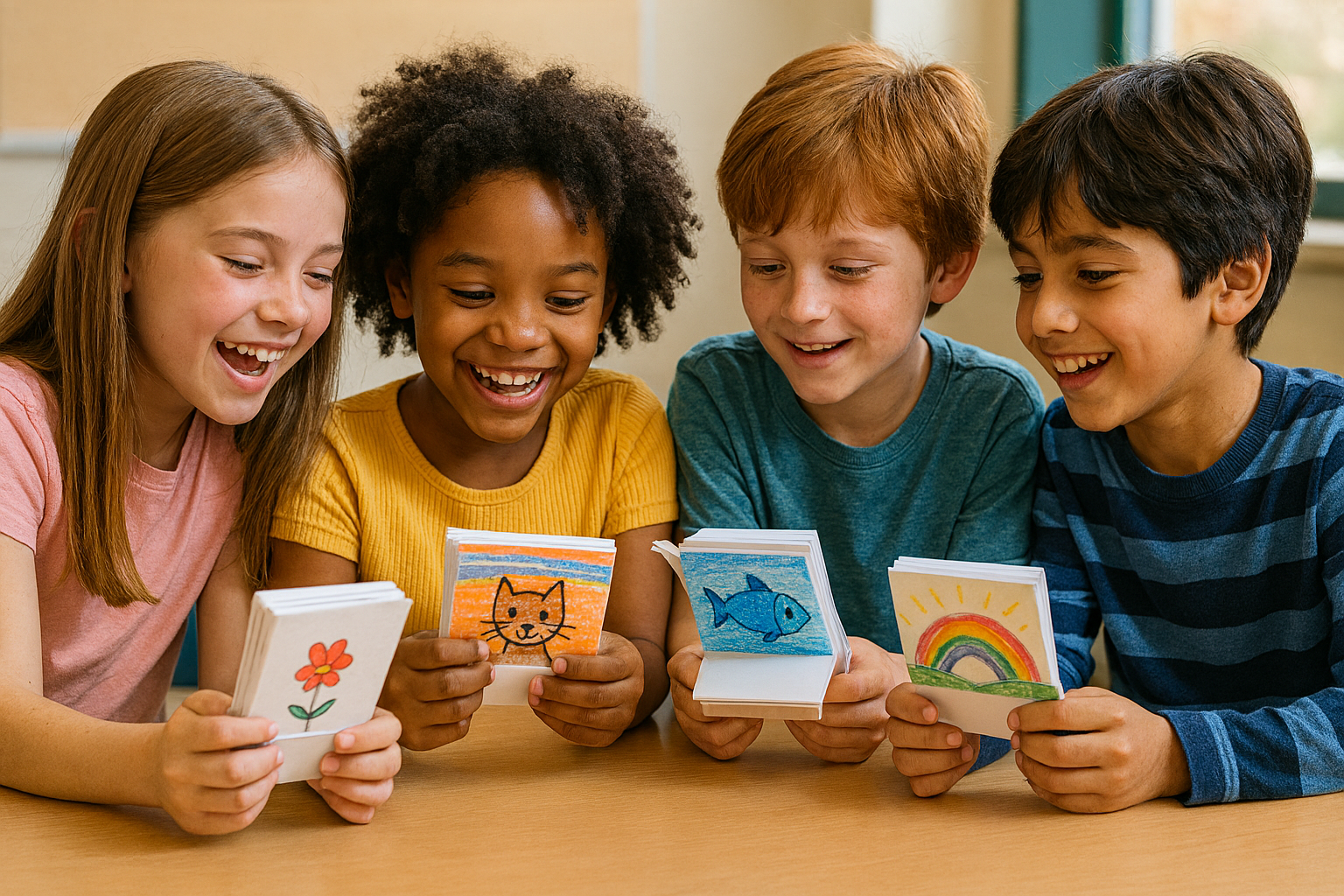

A Magical Craft for Late‑Elementary Creators
Flip‑book animation is one of those timeless crafts that feels like pure magic. With nothing more than paper, pencils, and imagination, kids can bring drawings to life, one tiny movement at a time. For late‑elementary learners, this project hits the perfect balance of creativity, challenge, and hands‑on fun.
Flip‑Book Animation Is Perfect for This Age Group
Late‑elementary kids are ready for projects that require:
- Longer attention spans
- More precise fine‑motor control
- Sequential thinking
- Creative problem‑solving
Flip‑books give them all of that in a playful, low‑pressure format. Kids at this age love seeing immediate results, and the “wow” moment when their drawings suddenly move is incredibly motivating. It feels like real animation because it is!
Developmental Benefits
Flip‑book animation supports a wide range of skills. Let’s take a look at how this craft challenges your child’s mind and body:
Fine‑Motor Development
- Repeated drawing of small, similar images strengthens hand control.
- Tracing and adjusting shapes builds precision and coordination.
Sequential & Logical Thinking
- Kids must plan how each frame changes.
- They learn cause‑and‑effect: “If I move the ball a little each time, it looks like it’s bouncing.”
Creativity & Visual Storytelling
- Children experiment with characters, motion, and simple narratives.
- They learn how visual choices affect the story.
Executive Functioning
- Planning a sequence
- Organizing materials
- Sticking with a multi‑step project
Emotional Benefits
- A strong sense of accomplishment when the animation works
- A confidence boost from creating something “professional‑looking”
- A calming, focused activity that encourages persistence
Let’s Get Started!
Supplies Needed
- Small stack of index cards, sticky notes, or cut paper rectangles
- Pencil or fine‑tip marker
- Colored pencils or markers (optional)
- Binder clip or rubber band (optional, for holding the flip‑book together)
- Lightbox or sunny window (optional for tracing)
Bonus: Are you missing index cards? I’ve got you covered! Simply download and print the flip book template below. You can print as many sheets as you need for free! After printing, cut out the rectangles and stack them to form your book.
Directions
1. Choose a Simple Motion
- Ideas: bouncing ball, growing flower, waving hand, rocket launch, blinking eyes.
2. Start with the First Frame
- Draw your starting image on the first card.
- Keep it simple and centered.
3. Create the Next Frame
- Place a new card on top.
- Lightly trace the original image.
- Change one small thing (move the object slightly, open the mouth a bit, tilt the head).
4. Continue the Sequence
- Repeat the process, making tiny changes each time.
- Aim for 10–20 cards for a smooth animation.
5. Test as You Go
- Flip the cards quickly to check the motion.
- Adjust spacing or movement if needed.
6. Add Color or Details (Optional)
- Keep colors consistent across frames.
- Add backgrounds only if kids are ready for the challenge.
7. Clip or Stack the Cards
- Use a binder clip or rubber band to hold the flip‑book together.
- Flip from the bottom corner for best results.
Extension Ideas
- Add speech bubbles for a mini comic‑animation hybrid.
- Create themed flip‑books (seasonal, science concepts, character emotions).
- Use them in a STEAM lesson on persistence of vision or early animation history.
RELATED: Watercolor Resist Paintings